The quantization white paper, five years later
Nagel et al.'s 2021 white paper is still the best single on-ramp into quantization, and it's the first stop in this site's reading chain. I read it against AIMET, the toolkit its authors built to ship its recipes, verified its core algorithms numerically, and marked what the LLM era kept, what it broke, and the one footnote that predicted the whole outlier crisis.
- Authors
- Markus Nagel, Marios Fournarakis, Rana Ali Amjad, Yelysei Bondarenko, Mart van Baalen, Tijmen Blankevoort · arXiv (Qualcomm AI Research) · 2021
- Audit
-
reference code read at
948a663· July 13, 2026 - Claims
- Note
Core insights. This is a tutorial, not a method paper, and its lasting contribution is a pair of recipes: a data-light PTQ pipeline (cross-layer equalization, then AdaRound, then careful range setting) that holds 8-bit models within 1% of float accuracy, and a QAT pipeline (fold the batch norms, initialize from the PTQ result, train through the rounding with a straight-through estimator) that makes 4-bit work. Nearly everything this site covers descends from vocabulary defined here. Reading it in 2026, three things stand out: the recipes aged well as structure even where the specific tricks died; the authors shipped the whole thing as a maintained toolkit (AIMET), which let me audit a white paper the way I’d audit a method repo; and one apologetic footnote about BERT (a few activations kept at 16 bits) is, in hindsight, the first published sighting of the outlier problem that LLM quantization has been fighting ever since.
Method
What simulated quantization actually simulates
The paper’s first service is defining the object of study. On real hardware, an int8 layer multiplies int8 weights against int8 activations into an int32 accumulator, adds int32 biases, and requantizes the result back to int8 for the next layer. Research code fakes this on GPUs with fake-quant nodes: quantize-then-dequantize operations inserted where the precision losses would occur, while everything still computes in floating point.
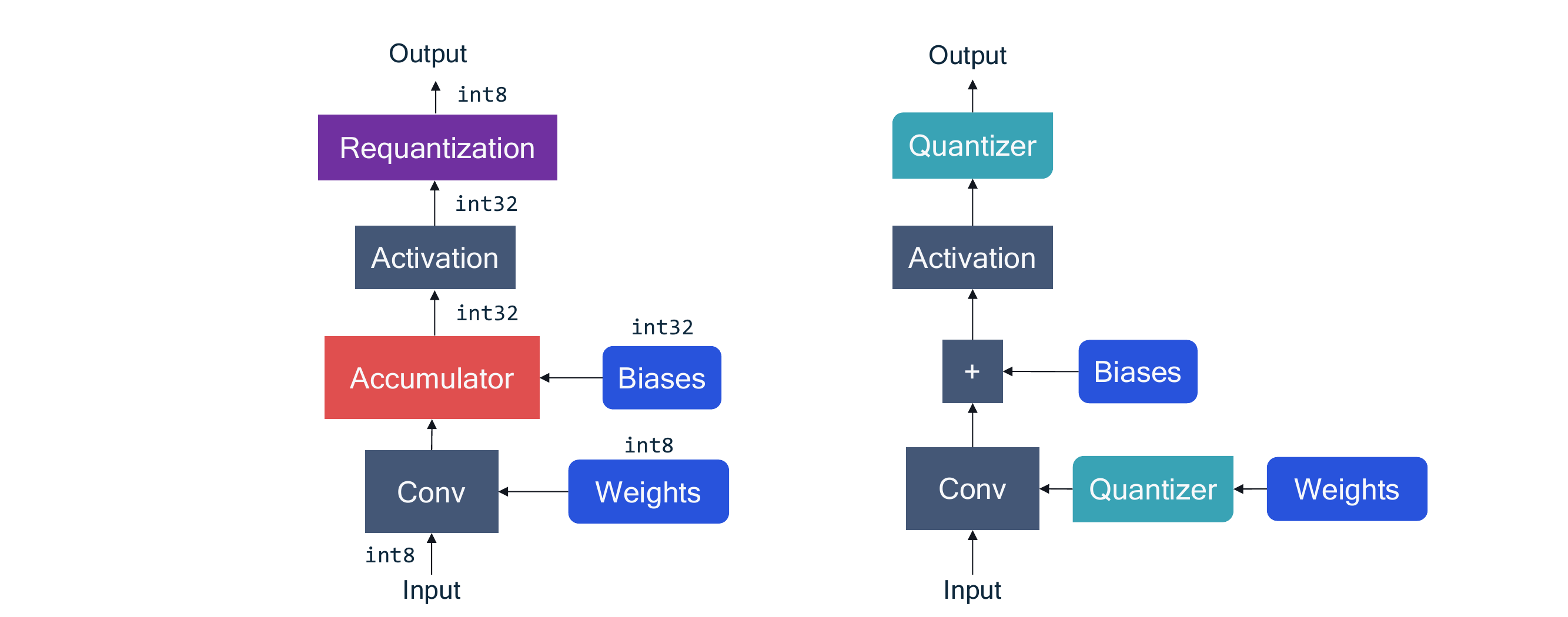
The grid itself is the same uniform affine quantizer we’ve now audited in three other notes: scale, zero point, integer clamp. The paper’s contribution is the decision table around it, defaults the field still uses: symmetric grids for weights (the zero-point multiplies against activations and would cost a data-dependent term otherwise), asymmetric for activations (post-ReLU distributions are one-sided; my check script measures a 4× MSE win for the zero point on rectified data), per-channel for weights where hardware allows. Every one of those defaults reappears verbatim in EfficientQAT’s quantizer and, with the symmetric-weights choice, in ParetoQ’s.
The PTQ recipe, and why each stage exists
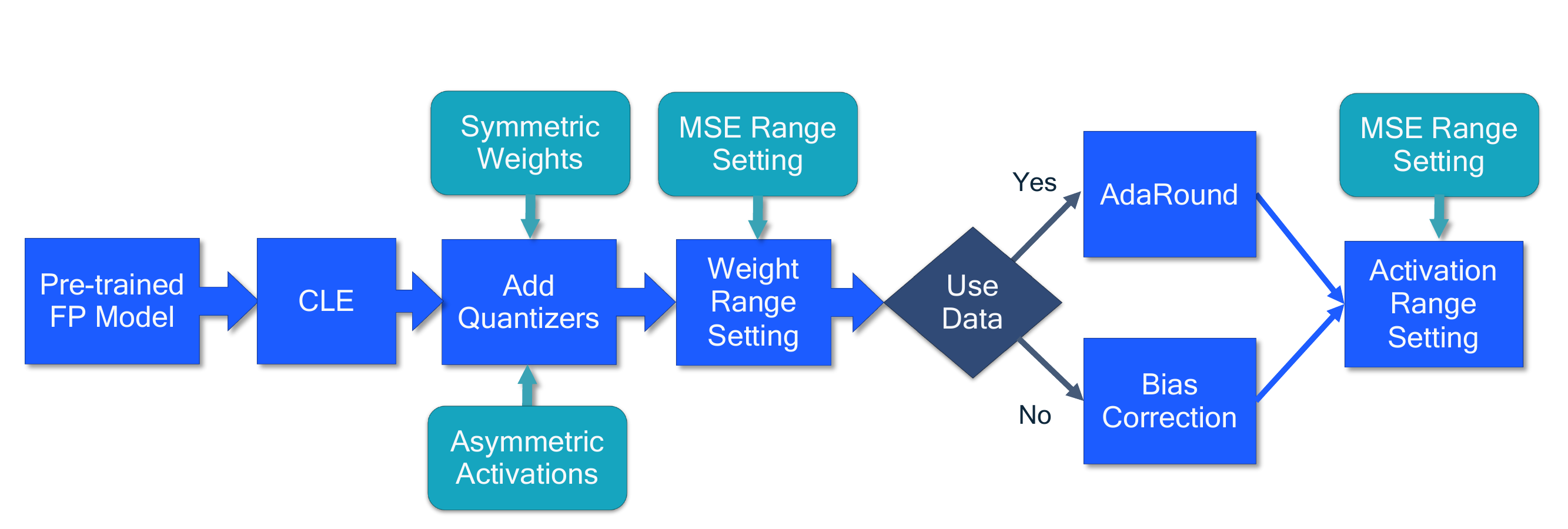
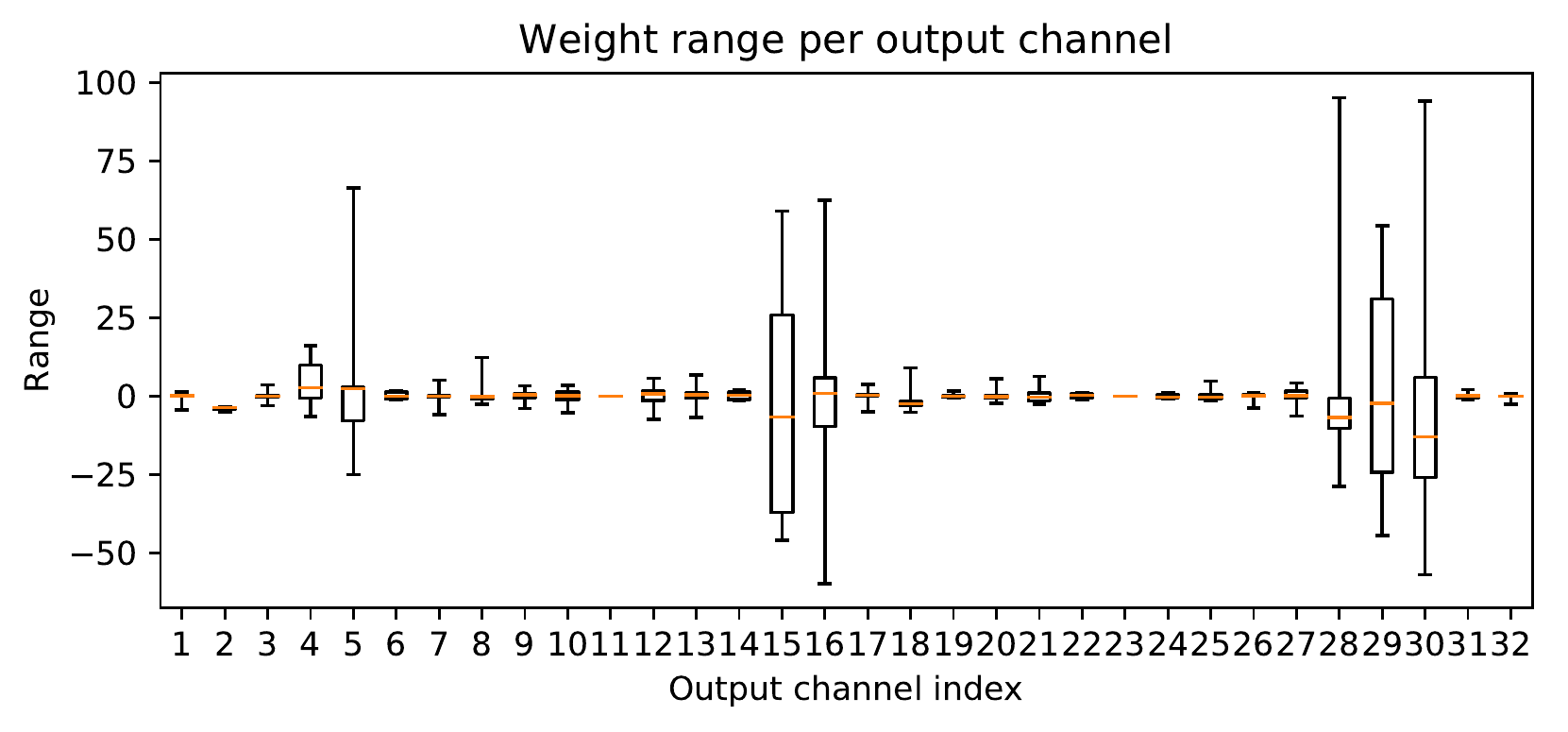
Cross-layer equalization attacks a problem I hadn’t appreciated until seeing their MobileNetV2 plot: per-tensor weight quantization dies when one output channel’s range is 50× another’s, because the shared grid must span the widest channel. CLE fixes it without data, exploiting the positive homogeneity of ReLU: scale channel of one layer down by and the corresponding input column of the next layer up by , and the network function is exactly unchanged, while the ranges meet in the middle. The optimal scale is , which equalizes the two layers’ per-channel ranges. I verified all three properties numerically: the formula matches AIMET’s implementation to machine precision, the ranges equalize exactly, and the function is preserved through ReLU to 1e-14.
AdaRound we’ve met in the Hessian note: round-to-nearest is provably suboptimal when weights interact, so learn the up/down choices per weight against a layer-wise reconstruction loss. The white paper presents the practical version: each weight gets a continuous variable squashed through a rectified sigmoid (stretched by ζ=1.1, γ=−0.1 so it reaches exactly 0 and 1 at finite α, unlike a plain sigmoid), plus an annealed regularizer that starts permissive and ends by forcing every weight to commit to a corner. I verified both properties, and the constants in AIMET (defs.py:331–332) are the paper’s.
Range setting is the quiet workhorse: min–max ranges are one outlier away from disaster, so grid-search the clipping threshold minimizing quantization MSE. On a synthetic heavy-tailed tensor my check gets 2.9× lower error than min–max at 4 bits. It’s the same range-versus-resolution trade the ParetoQ note wrestles with around scale initialization, solved here by brute force in 2021.
The QAT recipe
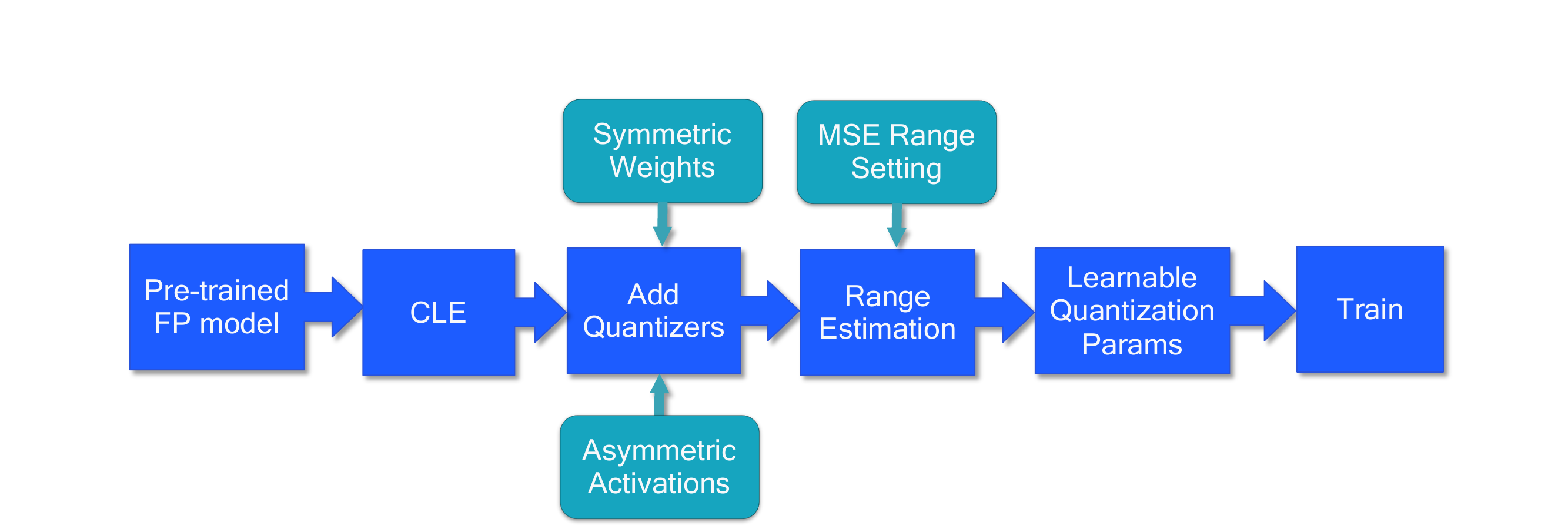
The QAT chapter is where the STE, learnable ranges (LSQ-style), and batch-norm folding get their canonical treatment. Two of its practical findings shaped everything downstream. First, fold the batch norms before training and quantize the folded weights; training with unfolded BN then folding afterward re-breaks the quantization. Second, initialize QAT from a good PTQ state: their ablation shows range-learning QAT recovers from bad inits eventually, but starts points ahead from an MSE-calibrated one. Both findings transfer beyond CNNs; ParetoQ’s 90/10 budget split is the same “start from the best cheap state” instinct at a vastly larger scale.
Paper vs. code
The white paper’s companion implementation is AIMET (Qualcomm’s AI Model Efficiency Toolkit), built by the same group, and it makes this the rare tutorial you can audit line by line. Repo at commit 948a663, actively maintained in 2026.
What I could match directly:
| Paper | Code |
|---|---|
| CLE scale | _aimet_common/cross_layer_equalization.py:492, written as ; algebraically identical (verified to 1e-16) |
| AdaRound rectified sigmoid, ζ=1.1, γ=−0.1 | _aimet_common/defs.py:331–332; loss in _base/adaround/adaround_loss.py with the paper’s warm start and β annealing |
| MSE-based range setting | the encoding-analyzer grid search machinery |
| Uniform affine quantizer, symmetric weights / asymmetric activations defaults | throughout quantsim |
What the code does that the paper doesn’t say:
- CLE guards against degenerate channels: scale factors that come out NaN, infinite, or zero are silently reset to 1.0 (
cross_layer_equalization.py:495–496). Dead channels strike again; every quantization implementation we’ve audited (GPTQ’s zeroed columns, this) carries an unstated epsilon-or-reset patch for inputs the math didn’t anticipate. - The 2026 AIMET has quietly become a museum of everything that came after the white paper: there’s a
test_spinquant.pyin the tree. The toolkit absorbed the rotation era its own paper predates. - And my favorite provenance find, in the LaTeX itself: a comment above the headline PTQ table admitting the numbers were assembled from multiple sources: “EfficientNet from the efficientnet slide deck, per-channel results from AdaRound slide deck.” The figures are literally exported corporate slides; one still has its “Confidential and Proprietary” footer in the PDF. Harmless, but a reminder that even the field’s textbook table is a collage, not one experiment.
Claims & evidence
| Claim | Evidence in paper | Verdict |
|---|---|---|
| The PTQ pipeline holds W8A8 within ~1% of FP32 across CNNs and BERT | Table 10, eight models, averaged over 5 runs | verified as reported; consistent with half a decade of deployment practice since |
| W4A8 is achievable with PTQ (AdaRound) | Same table; e.g. ResNet-50 75.15 vs 76.07 FP | verified as reported, with one honest catastrophic exception they print: EfficientDet-D1 collapses to 0.31 per-tensor |
| QAT buys roughly one bit over PTQ | Table 11: W4A4 QAT ≈ W4A8 PTQ territory | partial; holds in their tables for CNNs, and the LLM era complicated it (see ParetoQ’s compensation/reconstruction boundary) |
| CLE + bias absorption makes MobileNetV2 W8A8 usable without data | CLE ablation: 0.1% → ~70% top-1 | verified as reported; mechanism verified numerically here |
| BERT-base quantizes to W8A8 within 1% | Table 10, with the footnote: “a few quantized activations kept in 16 bits” | partial — true only with the escape hatch, and that footnote is the LLM outlier problem, eighteen months before LLM.int8 named it |
Benchmarks
The headline PTQ table, condensed (top-1 / task metric, higher better, average of 5 runs):
| Model | FP32 | W8A8 (per-tensor) | W4A8 (per-channel) |
|---|---|---|---|
| ResNet-50 | 76.07 | 75.87 | 75.43 |
| MobileNetV2 | 71.72 | 70.99 | 69.79 |
| EfficientNet-lite | 75.42 | 75.25 | 74.01 |
| EfficientDet-D1 | 40.08 | 38.29 | 35.08 |
| BERT-base (GLUE) | 83.06 | 82.43 | 82.02 |
Read it with 2026 eyes and two things jump out. The 8-bit column was essentially a solved problem in 2021 for CNNs, which is why the interesting frontier moved to 4 bits and below. And the one transformer in the table needed special treatment (activations at 16 bits) that none of the CNNs did — the shape of the next five years of quantization research, visible in a single footnote if anyone had known to look.
Limitations & open questions
Time is the main one, and it cuts in specific, instructive ways. CLE’s exactness depends on positive homogeneity, which ReLU has and GELU/SiLU do not, so the white paper’s flagship data-free trick is mathematically inapplicable to every modern LLM; its spiritual successor is the rotation family (SmoothQuant’s scaling, QuaRot/SpinQuant), which trades exact invariance through nonlinearities for invariance around them. The per-channel-ranges problem CLE solved got solved differently at scale (per-group quantization, as in EfficientQAT’s g64). And the paper’s activation quantization assumes distributions a calibration set can capture, which emergent LLM outliers broke; the BERT footnote was the warning.
What survived untouched is the skeleton: the quantizer decision table, MSE range setting, STE-based QAT with learnable ranges initialized from PTQ, and the debugging mindset of its diagnostic flowchart. Reading ParetoQ’s recipe against this paper’s QAT chapter, the differences are scale and grid shape, not kind.
One methodological note: as a white paper, it reports no error bars beyond run averaging, compares against no external baselines, and (per the LaTeX comment) assembles numbers from internal decks. It’s a codified best-practices document from one excellent industrial lab, and should be read as exactly that, which is also why auditing it against their own toolkit, rather than against rival papers, is the right check.
Reproduction notes
Marked partial, meaning: on 2026-07-13 I read the white paper against AIMET at commit 948a663, matching the CLE mathematics, the AdaRound loss and its constants, and the quantizer defaults; that’s the Paper-vs-code section. I verified the core algorithms in NumPy: the CLE formula equivalence, exact range equalization, and function preservation through ReLU; the rectified sigmoid’s saturation and the annealed regularizer’s minima; MSE-vs-min-max range setting under outliers; and the asymmetric grid’s advantage on skewed data. The script is verification/quantization-whitepaper/checks.py, eight checks, all PASS.
What I did not do: rerun any of the model tables (the 2021 training setups are only sketched, and the LaTeX comment about slide-deck provenance suggests exact reproduction was never really on offer), or run AIMET end to end on a real network, which would be the natural next step if a question about the pipeline’s current behavior ever matters to a note.